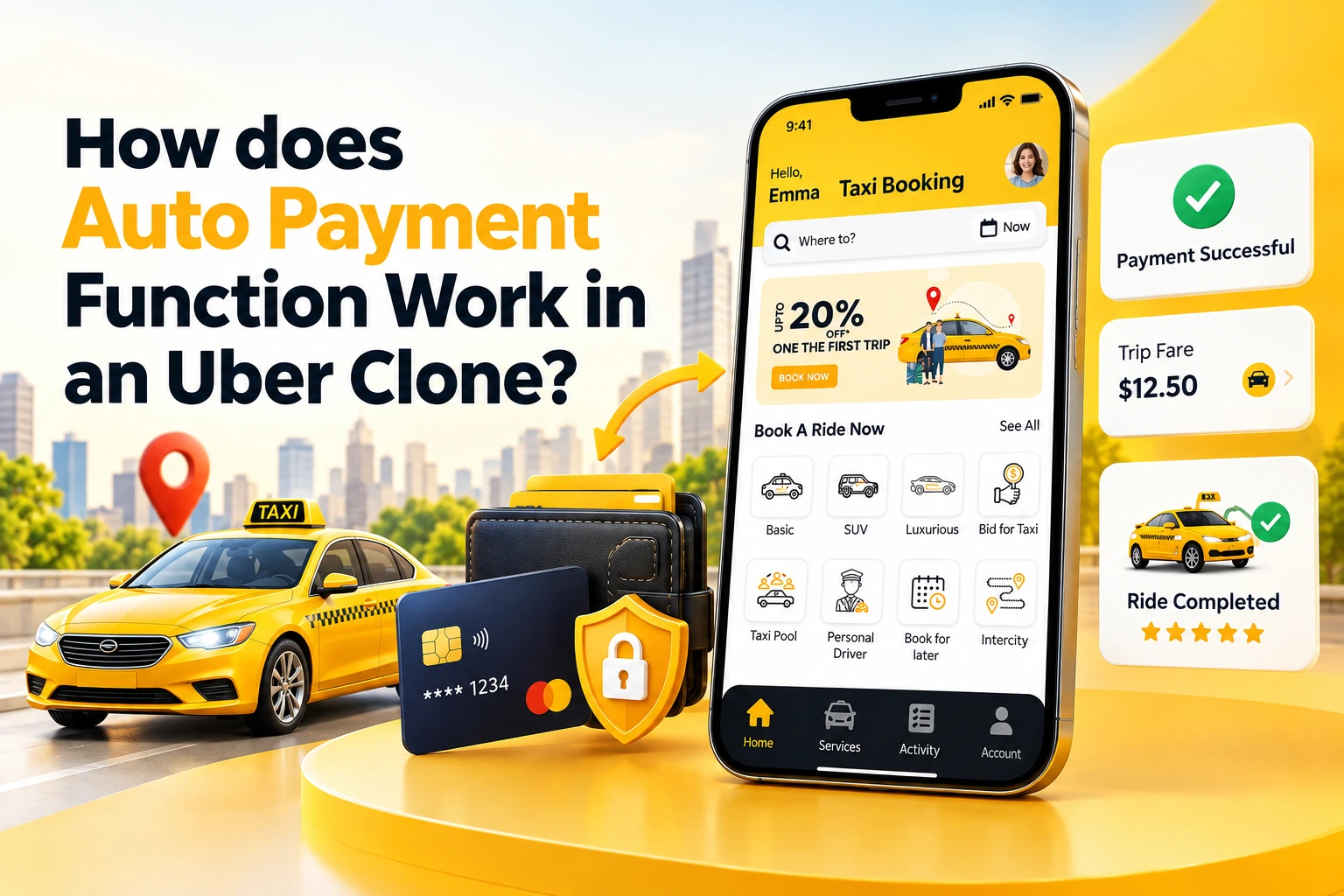
The payment experience can make or break a ride-hailing platform. Customers want to complete a ride without having to calculate, pay, and enter payment details at every stage. This is why an Uber Clone with an automated payment flow is a must for business owners who want to offer a convenient online taxi service.
Using an Uber Clone, a customer can authorize a preferred mode of payment, complete the ride, and have the final fare automatically charged. The process, however, encompasses a variety of functions such as calculating fares, authorizing and processing payments, providing receipts, and managing payment failures.
But how exactly does the process work, from booking to automatically deducting the amount due? Let’s take a closer look at the auto-payment functionality in an Uber Clone, including the step-by-step breakdown of how the system handles transactions.
What Is the Auto Payment Function in an Uber Clone?
The auto-payment function in a taxi app refers to a feature that enables the system to charge a customer’s preferred mode of payment once the ride is completed. Essentially, instead of asking the customer to make a payment, the platform calculates the final fare and initiates a payment request to the connected payment gateway. In other words, the process works as follows:
Book a Ride → Complete the Ride → Calculate Final Fare → Authorize the Payment → Deduct the Payment Amount → Provide Receipt
This approach is more convenient for customers and an organized way for businesses to collect payments. In general, Uber’s rider support notes that for digital-payment trips, the fare is automatically paid from the payment method on file.
How Does Uber Clone Auto Payment Work?
An Uber Clone auto-payment system works by linking the customer’s preferred payment method to the ride and initiating the transaction once the status changes to completed. The system also needs to account for variable fares, promotions, applied wallet balance, failed transactions, and receipts. Here is a step-by-step breakdown of how the Uber Clone auto-payment works:
1. The Customer Adds a Payment Method
The customer’s preferred mode of payment is added to their account on the platform as a card, digital wallet, bank transfer, or other approved method. The actual card or wallet details are handled securely by the payment service provider, and the application works with tokens or other representations of the customer’s payment information.
2. The Payment Method Is Selected for the Ride
Prior to requesting a ride, the customer selects the preferred payment method that will be used for initiating the transaction. The system associates the chosen payment method with the requested ride.
This is important since the customer could have multiple payment methods and would want to apply different discounts for different rides. According to Uber’s current help center documentation, a rider can choose a preferred payment method for a trip and change it or select another one during the ride, if applicable.
3. The Ride Is Initiated, and Fare Is Calculated
The driver accepts the request, and the ride begins. During the trip, the system collects data to be used to calculate the fare, including the distance covered, time taken, toll fees, waiting charges, and other applicable levies.
It is important to note that the initial estimated amount displayed to the rider may differ from the final charge due to variations in the calculation. Ideally, the Taxi app should be able to handle such calculations accurately to ensure that the correct amount is due upon arrival at the destination.
4. The Fare Is Automatically Deducted
Once the final fare is calculated, the system initiates a request to debit the customer’s chosen payment method. This is the main step in the auto-payment process, and it spares the rider the trouble of having to open a new screen to authorize every transaction after every ride. Essentially, the payment is automatically deducted per the authorization set up for the ride.
6. The Payment Is Confirmed, and the Receipt Is Generated
Once the payment has been successfully processed, the system confirms the transaction and generates an invoice. Ideally, the receipt should include the following:
- Final amount due
- Payment method
- Ride details
- Discounts and promotions
- Extra charges, if any
- Transaction status
This way, the customer has a soft copy of the payment details, and the business has a record of the transaction.
What Payment Methods Can an Uber Clone Support?
An Uber Clone can be configured to support a variety of payment methods, depending on the target audience and available options in the region. It is always advisable to offer customers a wide range of options to enable them to pay using their preferred method. Some of the payment methods that can be supported in an Uber Clone include:
- Credit and debit cards
- Digital wallets
- UPI
- Bank transfers
- Wallet balance
- Corporate accounts
- Cash
For instance, Uber has been offering multiple payment options in India, including UPI as a new payment method for its metro ticketing integration through ONDC.
What Happens If the Auto Payment Fails?
The auto-payment system in a Taxi app has to have an alternative plan in case of a failed transaction. There are several reasons why a payment could fail, including insufficient funds, expired cards, errors in the payment gateway, and network issues in the middle of the transaction.
The system should, therefore, have a failsafe mechanism to handle such situations. The following steps can be taken when a failed transaction occurs:
- Attempt to process the failed payment
- Prompt the customer to provide a new payment method
- Notify the customer of the failed payment and prompt them to settle the outstanding balance
- Depending on the payment gateway, the system can retry processing the payment request.
Why Is Payment Security Important for an Uber Clone?
Payment convenience is only valuable to customers if they trust the platform to keep their data safe. Businesses, therefore, need to ensure that they use a secure payment system that employs strong authentication measures, tokenization, encryption, access control, transaction monitoring, and proper handling of sensitive data.
In India, for instance, the Reserve Bank of India has put stringent security measures for processing recurring transactions, including e-mandate, requiring the cardholder’s consent before initiating any transaction. Additionally, the central bank has allowed card tokenization directly from card-issuing banks and other financial institutions, giving cardholders an alternative to using card PINs for payment authorization.
Source: Reserve Bank of India – Processing of e-Mandates for Recurring Transactions
For businesses, it is essential to ensure that an Uber Clone auto-payment system meets the security requirements for the region in which the application will operate.
How Can Businesses Make Auto-Payment More Flexible?
Customers use different payment methods, and a reliable Uber Clone needs to give them the flexibility to select their preferred option. At the same time, the business should be able to configure the application to only allow certain payment methods. The aim is to ensure that the customer is not overwhelmed by the number of options while still being able to choose their preferred method of payment.
Build a Smarter Payment Experience
A successful ride-hailing company understands that the payment process should be as smooth as the rest of the customer experience. An experienced Mobile App Development Company can help you build an Uber Clone with a reliable in-app payment system, including automated fare calculation and deduction, multiple payment options, receipt generation, refund tracking, and administrative controls. Whether you want to build a local taxi app or a full-fledged ride-hailing marketplace, an expert team can help you build a system that serves your specific needs and complies with local regulations.
Frequently Asked Questions
1. Is auto-payment a necessity in an Uber Clone?
Auto-payment is not mandatory, but it goes a long way in improving the overall customer experience. It also makes things easier for the business by minimizing manual interventions.
2. How does an Uber Clone Auto Payment charge customers?
A customer charges their account with an approved payment method and sets it as the default. Once a ride is completed and the final fare is calculated, the system initiates a payment request through the payment gateway and records the outcome of the transaction.
3. What happens if auto-payment fails?
The system can prompt the customer to authorize a new payment, retry the failed transaction, or mark the amount as outstanding, depending on the configuration. Generally, the payment gateway will determine how failed transactions are handled. It is, therefore, advisable to work with a reliable payment service provider that offers good customer support in case of a failed transaction.
4. Can an Uber Clone support UPI and digital wallets?
An Uber Clone can support UPI or digital wallets, depending on the payment gateways available in the target market. In general, the application can work with various payment methods, including cards, digital wallets, UPI, bank transfers, and others.
5. Is the payment gateway part of Uber clone development?
Payment gateway integration is part of the development process, but the transaction fees are separate from the development costs. It is, therefore, advisable to discuss the payment gateway requirements with your development partner and the payment service provider.

Uber App Clone introduces the great taxi on demand business solution by launching a Uber App Clone providing white-labeled uber clone apps available in different languages and currencies.