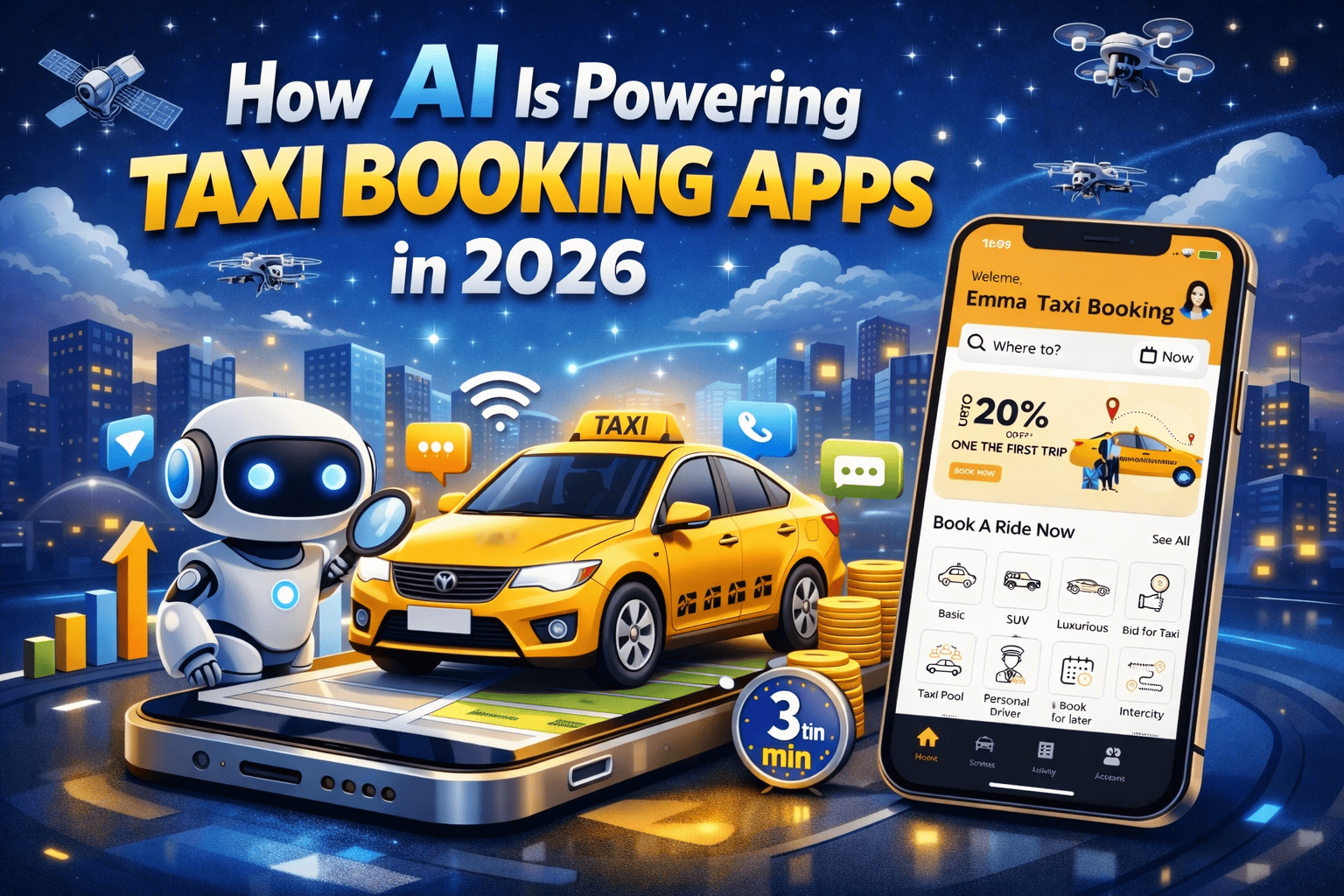
An AI taxi booking app is no longer an outlandish idea. In the U.S., 98 percent of people have a smartphone, and 91% have an iPhone. So ride-booking is available on the devices that people are using for payments, maps and chat. AI acceptance is growing quickly: McKinsey found that 65% of businesses will use the latest generation of AI by the year 2024. That is the new standard for any taxi business seeking to remain current on the U.S. market.
The Rise of AI
AI has transformed ride-hailing Business away from a simple booking tool to an intelligent service layer. The U.S. riders already are expecting quick responses, transparent prices and less hassle. AI assists taxi apps in meeting the expectations of customers by automating their conversations and predicting demand, increasing the speed of dispatch, and making customer service feel immediate instead of slow and unprofessional in the worst way.
When people think of “AI,” they often imagine chatbots, and only that. This is not enough. In a taxi service, AI can shape the entire journey, including the way a passenger books fares and how drivers are matched up, how fare rates fluctuate during peak times, as well as the way routes are picked and how quickly the system solves issues. McKinsey’s research has shown that consumers want individualized interactions and become frustrated when businesses do not deliver these. This is especially true for ride-hailing, as transportation is personal, sensitive to time and often stressful.
How does ride-hailing affect AI?
AI improves ride-hailing services by making them quicker and more accurate. It also makes it more scalable. Instead of relying on manual dispatch and support teams, AI taxi booking apps can anticipate demand, react to customers at all hours of the day, and cut down on the amount of time drivers are idle. This means less waiting time, more accuracy, fewer mistakes and a better experience for both parties.
Ride-hailing is a reality within the U.S. Since 2018, the number of smartphone users has only increased, so the market for mobile-based mobility via apps is vast and mobile-first. That’s the reason AI is important in this case. AI doesn’t create demand from the ground up. It allows operators to serve the demand that is already there more effectively.
AI helps improve the customer care aspect of business. Meta claims that its WhatsApp Business Platform helps companies deal with customer support by utilizing automated conversations, intelligent routing and backend integrations. In the case of ride-hailing, this results in faster booking assistance and faster resolution of issues, and fewer missed rides.
Benefits of AI in Taxi Apps
The most significant advantage of AI used in taxi apps is that it reduces friction across the board. The passengers get faster booking, more precise updates, and less awaited. Drivers benefit from better trip allocation as well as smarter earnings and fewer dead miles. Owners have greater control over costs for support prices, operations, and support. This is the reason AI is now a real business tool, not only an attractive feature.
There is also a compelling business argument for personalization. McKinsey discovered that seven percent of customers are looking for personalized service, and 76% are annoyed when they don’t receive it. A taxi app could use the information to make decisions in a practical way, including displaying preferred pick-up locations, suggested types of rides, saved addresses and booking shortcuts. Minor changes like this will make the app more discerning, more akin to a manual.
AI assists in helping customer service to scale, without transforming every single inquiry into a manual. Gartner forecasts that by 2028, at a minimum, 70 percent of customers will utilize an AI-based chatbot to begin their customer support journey. For taxi companies, this implies that riders are already comfortable with AI-led customer support. If your app isn’t able to respond to basic questions about bookings quickly and efficiently, customers won’t be patient.
Top AI Features You Need on your Taxi App by 2026
The most efficient AI features that can be found in taxi apps are those that help save time while reducing costs, as well as make your experience effortless. In 2026, this usually involves chat-based booking and driver finance tools, and routing optimization. These functions are best when they are integrated and not just as random additions you can throw in at an executive meeting.
Dynamic Surge Pricing
Dynamic surge pricing can help your platform adapt prices to the actual demand. When the traffic is a lot, or drivers are in short supply, or riders’ volumes increase, AI can adjust prices in real-time to ensure the system is in a balanced state. The goal is not to penalize riders. The goal is to ensure that the market is in operation when demand fluctuates rapidly. The research on AI-powered transportation has proven the ability of smarter technology to improve routes and decrease delays. This is the kind of intelligent pricing that should be based on.
WhatsApp Taxi Booking Chatbot
The WhatsApp taxi-booking chatbot is effective as it meets users at the point they are. Meta states that the WhatsApp Business Platform is built to help customers engage with their customers with two-way chats, as well as automated support flows and notifications. Meta also states that WhatsApp messages are viewed by 98% of users. rate, which is compared to just 20% of emails and this is the reason why conversational booking outperforms traditional support channels.
If you’re using the U.S. taxi company, it is beneficial in a simple way. Users can request a cab, confirm that they will be picked up, get updates on the status of their trip, or alter the route without having to open an app in a different way. This reduces friction and lets you get bookings back that would otherwise be lost due to the lag between curiosity and action.
Taxi booking via voice
Voice booking is helpful since it takes typing out of the procedure. This is important for those who are either driving older or exhausted from tapping at screens like they are working for nothing. With 91 percent of U.S. adults owning a smartphone, voice is the mobile lifestyle that already exists. It’s not a new thing. It’s a simple upgrade.
Voice booking is becoming a common customer service entry point. For taxi apps, voice booking can act as a fast lane for repeat users and accessibility-focused riders.
Easy Driver Payouts
Simple payouts to drivers build confidence. Drivers need to know when they’ll be paid, what amount is waiting to be paid, and if it’s fair. AI will help to automate payout schedules, identify irregular earnings patterns and provide precise pay summaries. This reduces support calls and can eliminate one of the main reasons for frustration on gig sites.
This is crucial for operators since driver retention is linked to the clarity of the system. A driver who is confident in the system that pays them is more likely to remain active, take a greater number of trips and view your website as a legitimate source of revenue rather than just an occasional annoyance that is merely an image.
Earnings Optimizer
An earnings optimizer will show drivers where and when they can earn more. It is able to identify high-demand areas as well as suggest the most productive times to be online, and also identify better travel patterns. McKinsey’s AI research has shown that businesses have already seen cost reductions and increased revenue from Gen AI usage, which is a testament to the notion that optimization tools can bring significant business value when they’re built on reliable information.
For drivers, this feature can be useful. Owners, too, can benefit from stabilization. If drivers perceive a path towards better earnings, they’re more likely to stay with the application running, remain in the loop, and drive when there are busy windows. This makes the whole network function more effectively.
Smart Route Intelligence
Smart route intelligence lets your platform choose the most efficient routes to pick-up and drop off in real-time. ScienceDirect’s 2025 review highlights that AI-powered solutions enable better traffic management, reducing delays and enhancing routes.It is also noted that the World Economic Forum has also pointed out that AI-powered optimization of routes can cut down on the inefficiencies that occur in real-time. For taxi apps, this means less fuel, fewer late pickups and a more pleasant rider experience.
This feature is also helpful in service reliability. If route intelligence is solid, ETAs become more trustworthy. This reduces complaints as well as stress for drivers and the uncertainty of riders. People are less willing to forgive when they’re on the curb and in the dark, wondering where their car went.
How do you create an app for Taxi Booking App with AI?
The best way to construct the perfect AI taxi booking app would be to begin with a white-label base and then add AI features that are crucial. This makes a white-label strategy an ideal option for those who need speed, but without rebuilding the entire system from scratch.
Purchase White-Label Script
A white-label script provides the booking engine’s core as well as the rider app, driver apps, administrator panel and dispatching logic. This is the foundation layer. It helps save time and lowers cost since you’re not having to develop each feature’s basic features from scratch. It is about structure first, and then intelligence later.
White-label customized
The customization process is where the platform is yours. You can customize your branding, local pricing guidelines, as well as your preferred payment flow, WhatsApp booking, voice booking and the logic behind payouts. Meta’s business tools demonstrate how conversations, along with support routing and backend integrations, are able to be integrated into messaging. This means that white-label taxi services can be made into more than just a generic booking duplicate.
Rapid Launch
The speed of launch is the main benefit. McKinsey discovered that the majority of generation AI implementations are in production in just about one to four months. This indicates that speed is achievable when the foundation is set. For taxi companies, this is important because timing of the market is often more important than perfect code. Fast launches allow you to test demand, gain insights from the riders, and make improvements before rivals copy the concept.
Conclusion
The U.S. mobility market already has the demand, mobile users, and AI capability. The most successful taxi companies in 2026 won’t be those with the most feature-rich lists. They will be those that have the most efficient booking process with the best routing, the most efficient support and the smallest amount of wasted time. AI can make it all easier to develop, and it is easier to expand. If you’re thinking of creating the launch of an AI taxi booking app, it is best to begin with a white-label Ai taxi booking app and layer AI into chat, pricing payments, voice and route intelligence. This will allow you to have a quicker launch, less risk, and a product made for the way U.S. riders actually behave in the present.