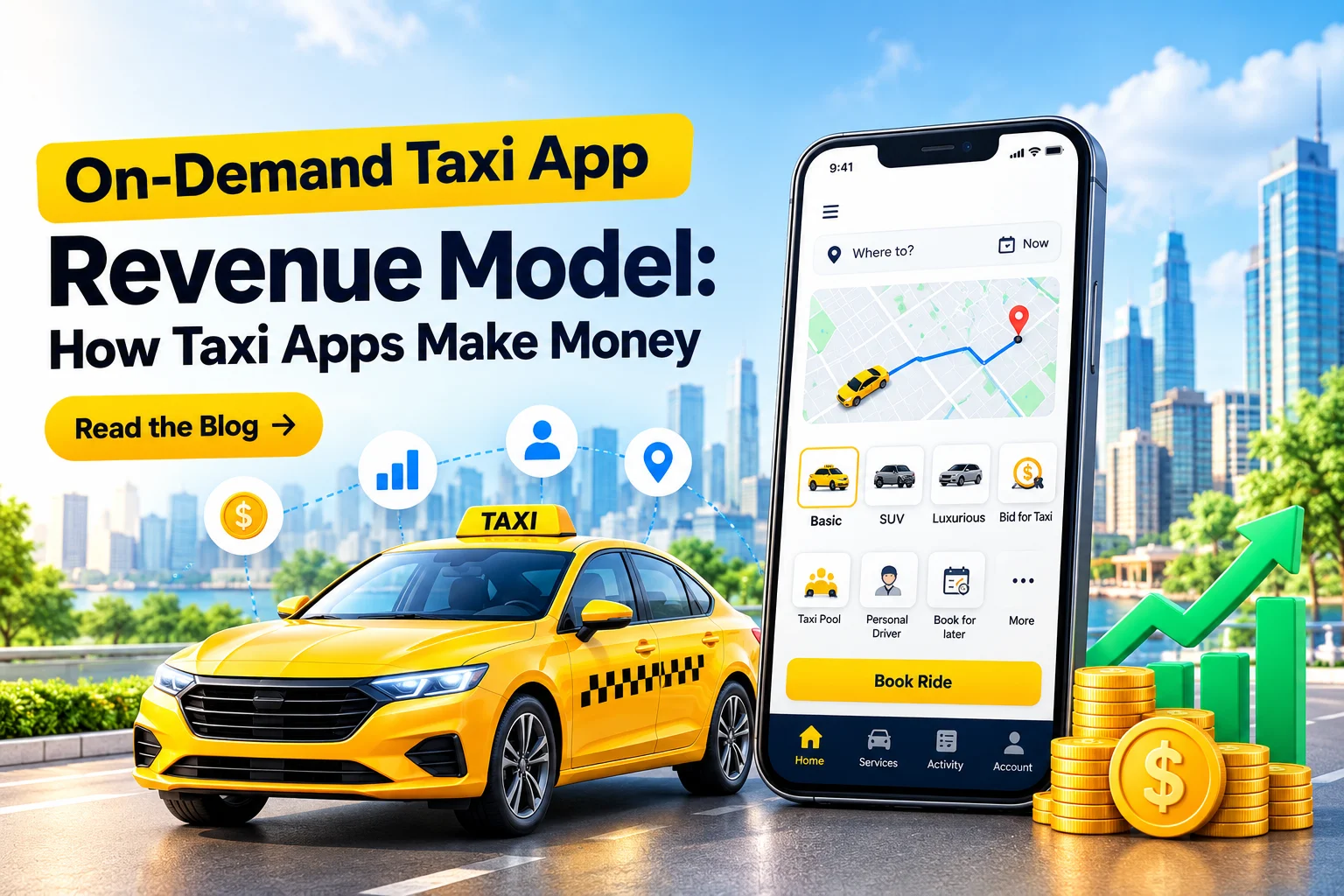
The taxi service industry is no longer about using traditional street-side bookings and has transformed into digital transportation services. Today’s riders want speedy booking, live tracking, honest prices, cashless payments, and dependable drivers.
This provides great prospects for entrepreneurs willing to start their own on-demand taxi app business. However, developing a good app is not enough to ensure success.
A successful business also needs to have a well-established monetization plan that will help you understand how your ride, booking, and services can be used in pursuit of growth.
Grasping the concept of the Taxi App Business Model will let entrepreneurs understand how to charge their riders, empower the drivers, manage commissions, and introduce alternative revenue streams.
What Is an On-Demand Taxi App Business Model?
The on-demand taxi service provides a good link between riders in need of transport and drivers who can transport them. The platform keeps track of bookings, payment processing, driver availability, fare charging, trip tracking features and communication between the two parties.
The business does not have to own all the vehicles. It can develop a marketplace in which independent drivers and fleet operators use the platform to provide their services.
This makes the Taxi Booking App Business Model different from a traditional taxi company. The technology platform becomes the connection between customers and transportation providers.
Revenue can then be generated through commissions, booking fees, subscriptions, premium services, advertising, corporate accounts, and other methods.
How Does a Taxi App Make Money?
There is no single Taxi App Revenue Model that works for every business. Many successful platforms combine several revenue sources rather than depending entirely on ride commissions.
For a new entrepreneur, an essential consideration is finding revenue streams that suit the target market while remaining reasonable to both customers and drivers.
A company could start only with a simple commission model and then explore other revenue streams as the customer base and network of drivers develop.
Strategy No. 1: Commission on Every Ride
The commission model has been widely adopted by taxi services for generating income from their taxi booking application. After the completion of the ride, a fixed percentage or amount is deducted by the platform, and the rest is paid to the driver.
For instance, if the ride costs $20 and the taxi service commission fee is equal to 15%, the business will receive $3, and the driver will get the rest after applicable adjustments. Moreover, the commission amount should be calculated based on the competition in the market, operating costs, drivers’ expectations, and customer pricing.
For a new Taxi Booking Business, starting with a transparent commission structure can make it easier to attract drivers while creating predictable platform revenue.
Strategy No. 2: Booking or Service Fees
Another possibility would be to impose a minor platform or booking cost on the normal fare charged to the rider.
The fee can be fixed or calculated according to the booking type. A business can charge different amounts for a typical ride, pre-booked journeys, rides to the airport, and luxury transport.
Nevertheless, the passengers must be made aware of the charge before completing the booking. A transparent fee structure is therefore an important part of Taxi App Monetization.
Strategy No. 3: Surge or Dynamic Pricing
The demand might fluctuate throughout the day. Certain places can experience high demand during business hours, weekends, festivities, events, or unfavorable weather. By using dynamic pricing, businesses can vary prices based on certain criteria and parameters.
The additional fare can increase platform revenue while encouraging more drivers to become available during busy periods.
Nonetheless, pricing has to be managed with caution. If prices are too high, customers will not use the service. Due to this, businesses have to find the right balance between revenue generation opportunities and reasonable prices.
Strategy No. 4: Subscription Plans for Frequent Riders
Not every customer wants to pay a separate fee for every benefit. Frequent users of a service might want to look into subscription plans. For instance, there may be programs that charge riders monthly in return for reduced booking charges, cheaper rides, priority reservations, and so on.
In the end, such a practice brings in stable revenue as well as gives riders a reason to come back and continue using the services. It is highly helpful when the taxi app business has already formed a steady customer base.
Strategy No. 5: Driver Subscription or Membership Plans
Revenue does not always have to come directly from passengers. Some platforms can introduce driver membership programs. By paying a flat fee each week or month, drivers can receive lower commissions as well as perks like enhanced access, extra tools, and other benefits.
A perfect model for high-volume drivers who prefer predictable costs.
However, businesses should understand driver economics before introducing such a model. The membership needs to provide genuine value rather than simply creating another cost for drivers.
Strategy No. 6: Corporate Transportation Accounts
Corporate transport could potentially become a significant source of revenue for many businesses that need transportation for their employees, clients, transfers from/to airports, meetings, events, and business trips.
A taxi platform can offer corporate accounts where businesses can manage their employees’ rides, set limits on expenditures, generate consolidated invoices, and monitor their transportation costs.
Corporate customers can generate regular booking volumes and provide a more predictable source of business than occasional individual bookings.
Hence, corporate transportation can become a potentially essential part of the Ride-Hailing Business Model based on entrepreneurs’ future revenue planning.
Strategy No. 7: Premium and Specialized Services
A taxi business does not have to limit itself to conventional taxi services. It can offer more luxurious vehicles, airport pickups, luxury transportation, vehicles that are wheelchair-accessible, and so forth.
These types of services entail various pricing models and commission rates. For instance, premium airport transport per booking earns more than normal taxi rides.
The key is to select services that have genuine demand in the target market rather than adding categories simply to increase the number of features.
Strategy No. 8: Advertising and Promotional Revenue
When a platform attains a large and active rider base, this can be a source of advertising revenue. Restaurants and stores, hotels, travel companies, taxi services, and local businesses may want to reach riders via the application.
The platform can sell paid catalogues, ads, promotions, and targeted offerings, thus introducing an additional revenue source without raising the fare charged to customers.
However, advertisements should remain relevant and should not interfere with the booking experience.
Strategy No. 9: Cancellation and Waiting Fees
Businesses can also generate revenue through clearly defined cancellation and waiting policies.
As an illustration, a client could cancel the service after a driver had already headed toward the meeting point. Likewise, drivers might need to be compensated for waiting for a long time. The exact policies should depend on local regulations and business requirements.
The important part is transparency. Customers should see applicable charges before or during the relevant stage of the booking.
What V3Cube Can Offer Beyond Basic Market Solutions
V3Cube can help entrepreneurs build a taxi platform with multiple revenue opportunities instead of depending on only one income source. The taxi services provided utilize technology to optimize the management of bookings, drivers, payments, pricing, and other transportation services.
Businesses can determine their own commission structure as they will only receive a percentage from the rides that have been completed. Thus, this establishes an instant source of income that can grow with the increasing number of bookings.
The platform can also help administrators manage driver commissions and payouts through the backend.
Final Thoughts
An on-demand taxi app can earn money through multiple revenue sources other than a standard commission on rides. Some examples are bookings, dynamic pricing, subscriptions, corporate accounts, luxury transport, advertisements, etc.
Always opt for a straightforward approach in developing the taxi application monetization strategy before advancing it as the business grows.
An entrepreneur planning to launch a taxi app business should look at developing a business model that riders and drivers find valuable enough to use again and again, rather than simply trying to maximize revenue from each ride.
FAQs
Q1. What is the most common Taxi App Revenue Model?
Commission on completed rides is one of the most common models. Additionally, it can be combined with other options like booking fees, subscriptions, corporate accounts, top-notch services, etc.
Q2. Can a taxi app have multiple revenue streams?
Yes. The app can employ several revenue generation methods together, like ride commissions, booking fees, corporate travel, etc.
Q3. How can a new Taxi App Business attract drivers?
Good commissions, clear earnings, flexible working conditions, stable payments, bonuses for drivers, and a simple application process make it possible to attract and retain drivers.
Q4. Is dynamic pricing suitable for every taxi business?
Not necessarily. Dynamic pricing should correspond to the current market situation and local regulations.

Uber App Clone introduces the great taxi on demand business solution by launching a Uber App Clone providing white-labeled uber clone apps available in different languages and currencies.