Choosing a suitable ride-hailing business model is an important step for entrepreneurs who want to enter the transportation industry.
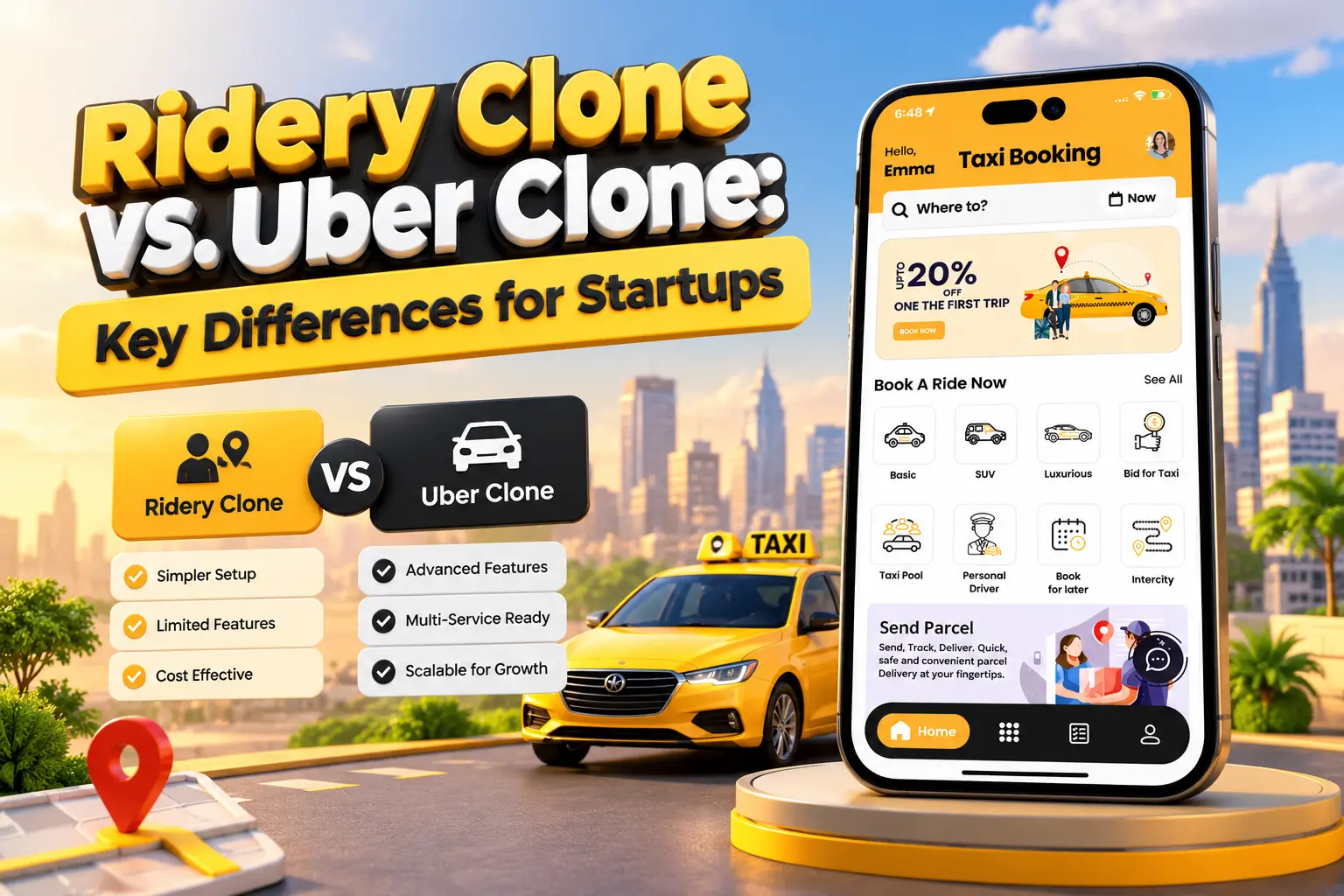
A Ridery Clone vs Uber Clone comparison provides an explanation of how various ride-booking concepts innovate the features of an application, techniques for strategizing pricing, management of the drivers, and eventual growth of the business.
Though both approaches have similar objectives of matching drivers and riders, the most suitable one between them depends on factors such as the market niche the app is used in, specifics of operation, and needed level of customization.
A clone app provides a software foundation based on another app. It is important to note that it is not enough to just duplicate another brand’s interface; it is necessary to create a product that incorporates local journey specifications and business objectives.
Understanding the Two App Models
A Ridery Clone app is a ride-hailing solution inspired by Ridery, a transport booking service that caters primarily to the Venezuelan market. Based on the business model that a business intends to use, the ride-sharing app can be customized according to the local transport requirements, driver onboarding, payment systems, and regional payment preferences.
An Uber Clone app is a customizable solution for transportation that is based on an Uber-style model. The software solution can be used for typical functions for transportation including requesting trips, matching with driver, GPS tracking, estimated cost, online payments, and rating the trip.
Neither model is automatically better for every business. In determining the preferable app model, businesses need to consider the service area, target audience’s preferences, operational model, as well as technical requirements.
Ridery Clone and Uber Clone Comparison
What sets each ride-hailing solution apart becomes more apparent when looking at potential business uses instead of assuming that every clone solution has identical capabilities.
| Comparison area | Ridery-inspired solution | Uber-inspired solution |
| Market focus | Could be appropriate for businesses examining region-specific ride-hailing uses | Can serve as a basis for a larger ride-hailing model |
| Customer experience | Can be customized for the target market | Can be configured around familiar ride-booking workflows |
| Pricing | Relies on the chosen software and regulations of the business | May provide configurable trip fares, costs, and pricing options |
| Driver management | Depends on available driver tools and integrations | May include driver onboarding, availability, and trip management |
| Expansion | Depends on the system setup options and architecture | Depends on the architecture, service module selected, and the operational planning |
This is a generalization of the differences in model, not an assurance that each product sold under either name will work as claimed. The actual functionality of each product depends on the provider, so it is necessary to have a working demonstration to confirm the claims.
Ridery Clone vs Uber Clone Features: What Matters Most?
The ideal way to approach this taxi app development comparison is to assess the features necessary for the profitability of the business.
Booking and location tracking
Riders need to be offered the ability to enter the pickup and destination location, view the available ride options, and to get relevant driver updates.
Fare calculation and payments
The platform should accommodate customizable pricing rules, provide estimates of the fare, record transactions, and process payments based on the local market.
Driver and administrator tools
The availability of drivers, trip assignments, supervision of accounts, customer service operations, and performance reporting to help in streamlining daily operations.
Safety and reliability
Knowing a rider’s trip history, ratings, and communication with support channels, as well as applying the right security measures, may help improve the riders’ and drivers’ confidence levels.
The optimal set of features is the one that supports the operational service model. For instance, a start-up in a single city may need a simple booking application; however, a bigger operator may need several vehicle choices, an advance reporting system, and more integrations if required.
Which Business Model Is Better for a Startup?
Either an Uber-inspired or Ridery-inspired platform can support multiple potential sources of income. The choice should depend on the local competition situation, drivers’ economics, and customer needs.
Commission-based model: The platform earns a percentage of each completed ride.
Booking fees: In addition to the fare, a rider has to pay for services, if applicable.
Driver subscription: The drivers pay a subscription fee for platform access if the business model is commercially suitable.
Corporate transportation: Businesses provide rides for employees, corporate clients, and for scheduled transport.
Premium ride options: The business may offer its clients more expensive services depending on demand and the availability of vehicles.
Before determining pricing strategy, startups should calculate the expenses related to software, marketing, payment processing, customer support, acquiring drivers for the bookings, and other expenses incurred in operating the platform.
Ride-Hailing Platform Comparison: Build From Scratch or Use a Clone Solution?
A ride-hailing platform comparison should not only study a particular app concept, but also pay attention to the technology required to launch it. Custom development permits more precise control of technical architecture and design, but can be more time-consuming and financially intensive for platform development.
A ready-made solution provides a pre-built foundation which can reduce the amount of software creation from scratch. Yet, customization, integration, licensing, and other support can play an important role in the overall project cost.
Before selecting a solution, businesses should verify:
- Whether applications for riders, drivers, and administrators are included in the system or not.
- Whether there is any integration of local payment systems or mapping services in the platform.
- How much branding and customization is provided in the platform.
- What licensing and source code ownership stipulations must be followed.
- Whether technical support and updates are available in the future.
A provider’s advertised feature list should always be checked against the actual product.
How V3Cube Can Help Build a Competitive Ride-Hailing App
The ready-made and customizable clone-app solutions offered by V3Cube help businesses provide digital services under their brand name. For entrepreneurs comparing various ride-sharing ideas, it can serve as a method of implementing the component without developing each element independently.
Potential benefits of a suitable V3Cube solution include:
A pre-built foundation: Fundamental components for booking can lessen the initial development process relative to building the platform entirely from the start.
Brand customization: Available options can help establish a distinct identity through the app interface and branding.
Configurable functionality: Businesses can analyze offered modules and specify the features that cover their operational requirements.
A more structured launch process: A pre-built starting point may help organize development around the features needed for the initial market.
The most important benefit is that it is possible to assess a customizable solution, as opposed to committing to a completely bespoke build. But V3cube should not be assumed to include all the required features and integrations for a Ridery application in their offered package.
Before selecting a package, it is recommended that businesses ask for a live demo as well as check the pricing structure, driver allocation, GPS tracking, payment integration, licensing conditions, customization expenses, scalability, and post-launch support.
This facilitates the comparison of V3Cube to other platforms in terms of practical utility rather than marketing promises. This allows businesses to assess V3Cube objectively compared to alternative providers.
Conclusion
The selection between a Ridery-inspired platform and an Uber-inspired platform relies on factors, including the targeted audience, preferred features, pricing policy, and long-term business aims. It is always more beneficial to measure the true potential of the platform’s capabilities than just to rely on the provider’s reputation.
V3Cube provides a way to achieve flexibility in the development of a ride-hailing app for businesses seeking the same. Evaluating the live product, integration options, total cost, licensing policy, and support will let businesses conclude whether this is a suitable foundation for a new transportation platform.
More information is available on the official V3Cube website: www.v3cube.com
FAQs
What is the main difference between a Ridery clone and an Uber clone?
Both concepts refer to similar ride-hailing software applications. However, the difference between them will depend on the target market, business needs and particular features in the specific solution.
Which option is more suitable for a new taxi business?
Both of them may fit. The selection will depend on the intended service area, pricing scheme, required functionality, funds available, and capabilities of the vendor.
Can a clone app be customized with a different brand name?
Many clone apps have branding customization, but it is better to ask the provider about the specific option before buying the software.
How much does a ride-hailing clone app cost?
Costs depend on applications included, features, customizations, and licensing. Detailed quotations will be a proof of an accurate estimation of the investment needed.

Uber App Clone introduces the great taxi on demand business solution by launching a Uber App Clone providing white-labeled uber clone apps available in different languages and currencies.