Key Takeaways
- Ride Hailing in Thailand has a strategic demand for corporate rides.
- Launching an Uber Clone faces 5 Critical challenges.
- Legal Compliance is an issue which people ignore until the launch. The solution to it is a simple legal framework and a white-label development process.
- Scammers in App Development is yet another critical issue for which the simplest idea is to check testimonials and ask for legal NDAs which scammers don’t provide.
- Gojek & Grab are constant competition for your Uber Clone, marketing with a clear positioning for corporate rides is the best option for gaining a decent share in the first year.
- Post launch maintenance and fast launch is a critical demand for any app owner, launching without them is depreciative. Hence, choosing white-label can simplify the costing.
Introduction: Need of Uber Clone in Thailand
Ride-Hailing Market has evolved globally. Today, it’s more than just having a ride in minutes and Thailand’s emerging demand is no exception. With the emergence of super apps in Thailand, many people feel the need of specialized taxis.
Many of these people are from a certain demographic:
- They need luxury.
- They ride for business needs.
- They want smoother experiences.
This why many people demand a corporate Taxi service which serves the everyday working class with simplified methods. An Uber Clone is a perfect choice if you want to start your own Taxi App in Thailand.
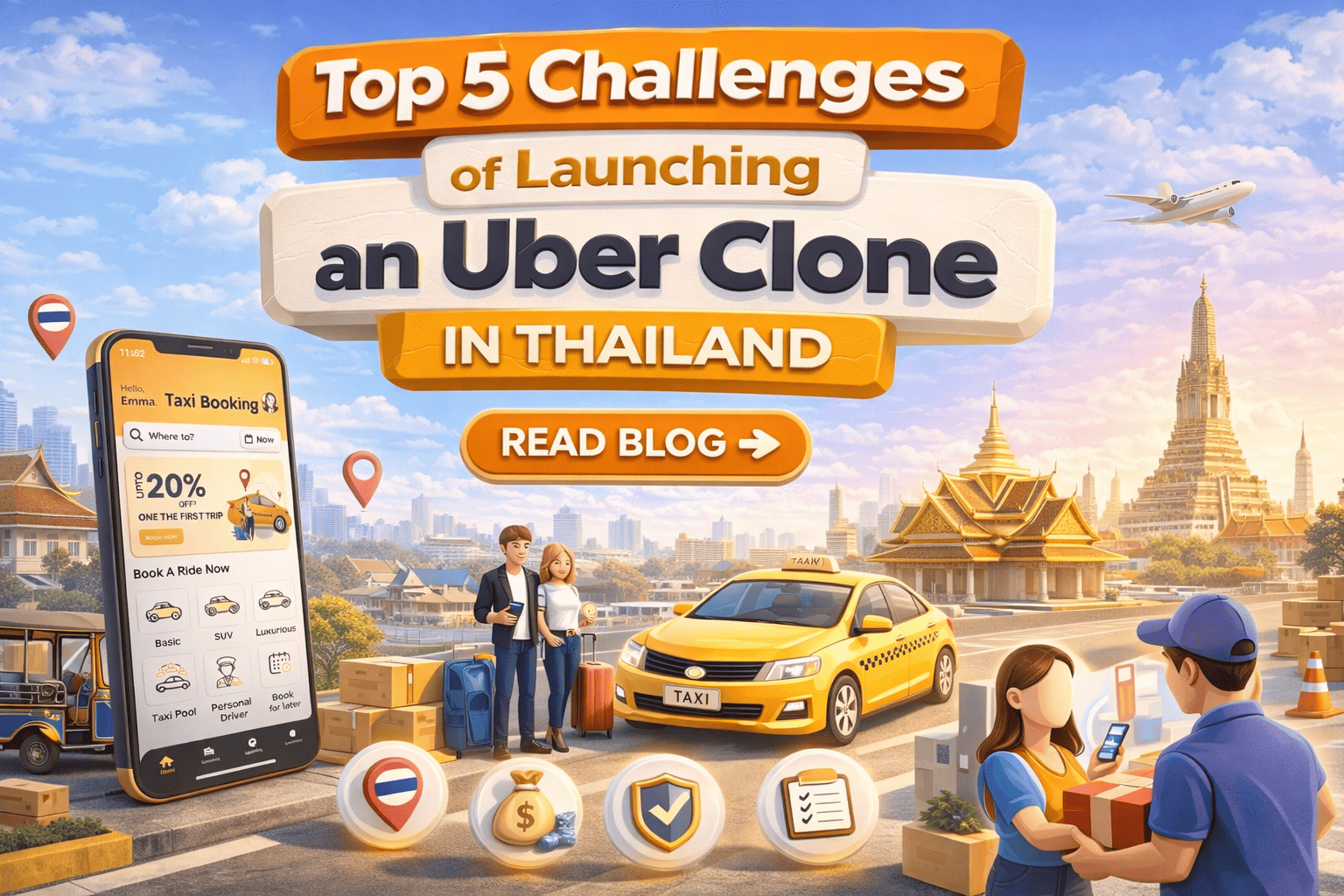
However, there are 5 Challenges which every Founder faces when launching their own Uber Clone in Thailand. This guide takes you through that and gives you a resolution for each problem.
Challenge #1: Legal Compliance
Legal compliance is the most silent deadline founders fail to meet. If you want to launch the creation of an Uber Clone in the country you need to translate transportation laws as well as driver vetting regulations passengers-safety regulations, and data-privacy laws into requirements for the product before even a single page of your code has been blocked. If you don’t, you’ll face penalties, regulatory delays or forced rollbacks. Begin with a sensible legal framework that maps required licences KYC and logs of rides and payment compliance to specifications for feature. Partner with local counsel on converting laws into acceptance criteria, and select an Uber Clone Development Company or white-label partner who can provide conformity-ready software and documentation. This reduces time to market and makes audits a manageable process, so launch plans won’t be shattered during the week leading up to go live.
Challenge #2: Scammers in Uber Clone Development
The market is full of “developers” who offer demos, then disappear. Some of the most frequent traps include non-transferable and plagiarized source code or IP terms, incomplete deliverables as well as no post-launch support. Make sure your project is protected by the proper use of contracts: signed NDAs, milestone-based payment and escrowed source code, or confirmed Git histories, as well as staging access to a live demonstration or staging area. Verify vendors by examining reviews from clients, calling references, and verifying legal SLAs. If a vendor claims a speedy 1-2 week launch, but refuses to accept the source-code handover, leave. Choose vendors who offer the free tech support included in Uber Clone packages for a time frame in addition, insist upon a regular SLA to ensure that you know that the “final delivery” will not be the beginning to your nightmares.
Challenge #3: Market Competition in Thailand
Competing in ride-hailing demands surgical positioning but not stadium-level advertising. Super apps that are incumbent such as Gojek and Grab offer services and demand attention from users. An Uber Clone App that tries to compete with them in terms of spending will not succeed. Instead, select a specific sector: corporate travel shuttles to the airport, fleets of luxury or B2B travel on subscription basis. Partner with specific alliances: hotel travel desks for corporate clients or fleet operators as well as a distinctive UX designed for business customers. Make use of the Best Uber Clone Script or a white-label solution to speed up the start-up, and then employ laser-focused marketing to secure early corporate contracts and steady revenues instead of an expensive user-acquisition arms race.
Challenge #4: Time to Market
Speed beats perfection when proving a product’s market suitable to the Uber Clone. Long custom builds make incumbents respond and deplete runway. The best approach is to follow an MVP-first approach: Prioritize matching, booking, payments, drivers’ onboarding, support flows. You can then refine by observing live usage. Include localization, such as languages local payment gateways, language and regulatory hooks into the first development rather than adding on them later. Making use of the power of an Uber Clone Development Company or an existing script could reduce development time by a significant amount and allow for that promised two weeks speedy launch time, provided that it is governed. Speedy launch provides real-world data that is the most effective method to determine what features to expand to the next level.
Challenge #5: Post-Launch Maintenance
Shipping the application is just Step One. Post-launch requires continuous operations that include 24/7 tech support, regular updates and server scale to accommodate spikes drivers and riders onboarding enhancements, fraud monitoring and fast fix for bugs. Don’t pay attention to maintenance and you’ll receive low ratings, a high rate of rate of churn and even downtimes that are more expensive than regular operations could have. Create an SLA with specific response times, an update schedule, and escalation routes and set aside at minimum three months of continuous operations support. White-label vendors often offer technical support at no cost in Uber Clone packages for an initial time frame; it’s important to consider as it helps bridge the gap between early ops and helps prevent small glitches from turning into outages that damage brands.
Complete Checklist for Smooth Development of Uber Clone
Now, let’s summarize what you’ve learned so far and make a checklist that you can solve by just ensuring that your app development process is smooth.
- The firm provides White-Label Development.
- The firm gives extra perks like Tech Support & App upgrades.
- Firm can launch in just 1-2 weeks.
- The firm provides compliance ready Uber Clone.
- The firm provides source code.
- The money and idea is NDA protected.
In Conclusion,
Launching a Taxi App in Thailand is a great opportunity, however, developing an Uber Clone in Thailand is a work full of challenges, yet very critical. People face challenges like slower time to market, not knowing how to launch an app, what are the legal frameworks needed to launch in Thailand, post-launch maintenance, time to launch in the market, competition with super apps, etc. However, a simple Checklist above can solve the thing and help you develop in just 1-2 weeks with a white-label developer. Choose your preferred white-label developer with the checklist, start with real-time working demo today!

Uber App Clone introduces the great taxi on demand business solution by launching a Uber App Clone providing white-labeled uber clone apps available in different languages and currencies.