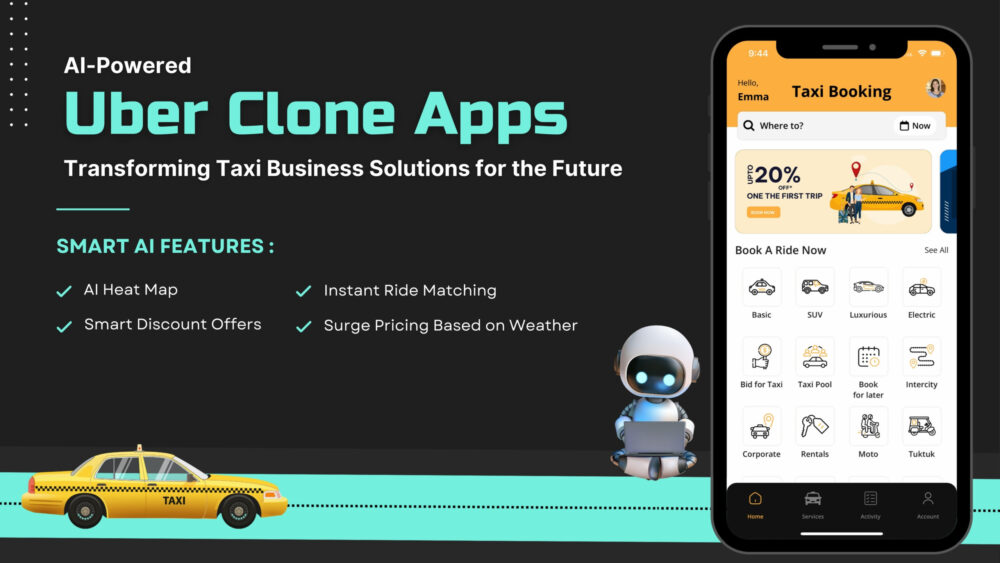
Smarter Taxi Business Solutions with AI Driven Uber Clone Apps
The on demand taxi industry has always been about efficiency. While it may seem that the sole focus of the Uber clone app based business is to move people from point A to point B quickly, safely, and at a price they’re comfortable with, the truth is that it is much more than that. The on demand online taxi booking business is not just about transportation. It is about convenience and empowering people with futuristic advancements.
But in 2025, efficiency doesn’t mean just having enough cars on the road or ensuring drivers know the fastest route. It means using data in ways that were nearly impossible a decade ago. That’s where AI driven Uber clone apps step in.
Think of it this way: riders expect near instant pickups. Drivers want predictable earnings. Operators need lower costs and better margins. Put all that together and you have a balancing act that’s too complex to manage manually. Smarter taxi business solutions, powered by AI, allow each of these moving parts to work in sync, not perfectly, not without hiccups, but far more intelligently than before.
From Simple Apps to Intelligent Platforms
When ride-hailing apps first arrived, the pitch was simple: a button on your phone brings a car to your location. That novelty is gone; everyone offers it. What differentiates a smarter taxi business solution today is the intelligence behind the curtain.
An AI driven Uber clone app doesn’t just connect driver and rider based on distance. It looks at time of day, traffic history, likely drop off locations, driver preferences, even events in the area. That kind of complexity helps reduce cancellations and makes the service feel smoother, almost invisible. Riders don’t notice the system at work; they just know their car arrived faster than expected.
Demand Is Predictable, If You Let the Data Talk
Every taxi operator knows Friday nights are busy. But exactly where and when? That’s where predictive demand comes in. AI models trained on ride history, weather, and event data can say: “Expect a surge near the stadium between 9–11pm” or “Rain tomorrow morning will double demand downtown.”
Instead of scrambling reactively, drivers can be repositioned ahead of time. This not only reduces wait times but also makes drivers feel the platform is working in their favour. One operator who applied predictive forecasting saw idle driver time drop by nearly a third. That’s huge when margins are tight.
Route Optimisation Isn’t Just GPS Anymore
Most apps already show drivers the fastest route. But AI adds nuance. Suppose a particular road usually clogs up right after school hours, or a narrow lane consistently confuses GPS signals. AI can learn from thousands of past rides and adjust accordingly.
The result isn’t always the absolute fastest trip, sometimes it’s the most reliable one. Riders value predictability as much as speed. That reliability is one of the quieter but more powerful aspects of AI driven routing.
Smarter Pricing Without Scaring Customers
Dynamic pricing, or “surge pricing,” has been controversial from day one. Riders complain when fares jump too high, and regulators often step in. But AI allows for a more balanced approach. Instead of blunt multipliers, algorithms weigh supply, demand, trip distance, and customer behaviour.
For example, the system may apply a gentle 1.2x increase across a neighbourhood rather than a sharp 3x spike. The ride still costs more, which helps draw in additional drivers, but without alienating the very customers you’re trying to retain. Businesses that fine tune pricing logic this way tend to face fewer complaints while still achieving the supply demand balance they need.
Safety and Trust: Where AI Quietly Works Hardest
AI contributes in ways that aren’t always visible. Monitoring braking, acceleration, and speed helps flag risky drivers. Fraud detection tools catch unusual ride patterns or suspicious account activity. Even customer complaints can be triaged with natural language processing to identify urgent issues faster. In competitive markets, trust can be the deciding factor in whether riders stick with your platform.
Drivers: Partners, Not Just Contractors
If riders are the heart of the system, drivers are the backbone. AI can improve their experience too. Imagine giving a driver a daily earnings forecast based on demand predictions, or routing them toward neighbourhoods with high acceptance rates. Little touches like this change how drivers view the platform, less as a faceless system and more as a partner in their success.
Retention matters. Recruiting new drivers is costly. Keeping existing ones happy with smarter tools and fairer pricing keeps the business sustainable.
Beyond Rides: The Bigger Picture
Here’s the thing: an AI driven Uber clone app doesn’t have to stop at rides. Once the infrastructure is there, mapping, routing, driver management, payments, adding adjacent services becomes easier. Think parcel delivery, grocery runs, or partnerships with local businesses.
This expansion is where “smarter taxi business solutions” become something larger. A company might start with simple ride hailing, then layer in package delivery by day, late night rides from entertainment districts, and even EV charging partnerships. The data gathered in one service fuels intelligence in the next.
The Implementation Side Few Talk About
It sounds futuristic, but rolling out AI features isn’t plug and play. You need data pipelines, compliance with local privacy rules, and infrastructure strong enough to handle real time decisions. Even a split second lag in route optimisation can frustrate both drivers and riders.
Then there’s the human side. Drivers need to trust monitoring features won’t penalize them unfairly. Riders need transparent communication about pricing models. Regulators will want clarity about how your algorithms work. Ignore these and you risk backlash that undermines even the smartest system.
Common Pitfalls to Avoid while developing Uber clone
Plenty of businesses rush into AI adoption and stumble. The most common mistakes?
- Rolling out too many features at once instead of focusing on two or three high impact ones.
- Underestimating the cost of training and maintaining AI models.
- Forgetting that not every market has rich historical data to feed into demand forecasting.
- Assuming drivers and riders will automatically embrace changes without clear communication.
Every mistake here can be mitigated, but only if businesses approach AI adoption with patience and pragmatism.
Strategy: A Practical Rollout Roadmap
If you’re serious about building with AI, start small. Launch your Uber clone with essential features, booking, payments, driver rider matching. Then layer in smarter elements. Begin with demand forecasting and route optimisation; they usually deliver the quickest returns.
Next, improve safety features and analytics dashboards. Once you’ve proven those, tackle pricing optimisation. Finally, when your system is stable, explore expansion into multi service territory.
It’s a staged approach. It may not look flashy on day one, but it builds long term resilience.
Where the Market Is Heading
Industry trends suggest taxi businesses are moving toward more sustainable and eco friendly operations. EV integration is becoming standard. Governments are incentivizing cleaner fleets. They don’t just want a car; they want real time transparency, loyalty rewards, safer rides, and even carbon footprint tracking. Businesses using clone apps with AI built in can meet those expectations faster than those trying to bolt on solutions later.
The Competitive Edge
What happens if you don’t adopt AI? You risk falling behind. A competitor with smarter route optimisation gets better reviews. Another with demand forecasting retains more drivers. Over time, the difference compounds.
But the businesses that embrace it now are setting themselves up for long term wins.
Conclusion
Smarter taxi business solutions with AI driven Uber clone apps are no longer futuristic concepts, they’re quickly becoming the industry standard. All of it is achievable within the framework of a well designed Uber clone app, provided businesses roll out carefully and respect both users and regulators. The future of taxi businesses isn’t about who has the most cars or the biggest advertising budget. It’s about who can use intelligence to deliver smoother, safer, more reliable services at scale.

Uber App Clone introduces the great taxi on demand business solution by launching a Uber App Clone providing white-labeled uber clone apps available in different languages and currencies.