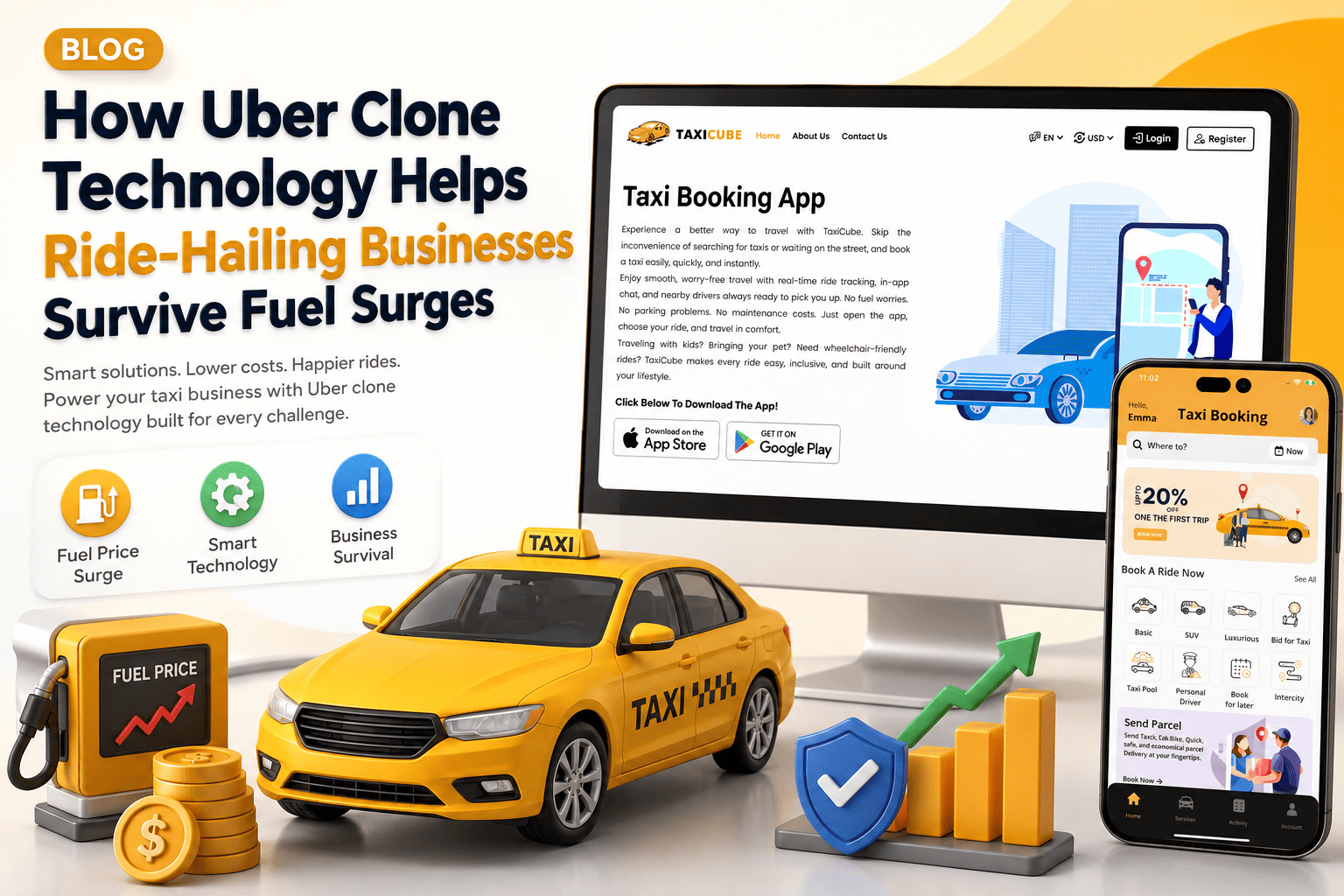
Post when the cost of crude oil decides to embark on a confused Tuesday in Parliament, the enormous technology firms in Silicon Valley simply make an adjustment to an algorithm. However, when you are operating a freshly deployed Uber clone script, the fact that you are running is a statistical anomaly. It is, in fact and quite literally, the literal reality of the fact that your fleet is collapsing in real-time.
Introduction
You are sitting there with your admin dashboard. You’ve got your driver heatmaps open. Then, all of a sudden, it is 5:00 PM, the rush hour is beginning, and the map is cold. Your drivers are passing off.
Why? Since independent drivers do not engage in anything more complicated than fractional calculations of gross platform earnings. They check the pointer on their dashboard. When the price to fill the tank rises by a factor of two, i.e., fifty rather than thirty dollars, the psychological resistance is rapid.
When your base fare and per-mile rates in the admin panel are still not adjusted to the parameters of last month, every single ping that they receive serves as an insult.
The collateral victim in this case is the deadhead issue. When a driver is sitting downtown and is pinged in the suburbs, he/she must compute those empty miles.
In fact, hold on; we should not even consider drivers for a moment. Now we shall swing over to the rider side, as here we find the very panic itself.
How Uber Clone Help Operators Respond to Fuel Price Shocks
Whether you simply set the global surge multiplier to 1.5x in order to compensate the drivers on fuel, instantly you ruin your rider conversion rate. Which, when you consider the rider side of the app UI, only makes perfect sense. The rider gets into the app. They are presented with the estimate of the fare.
In the event you typically make $12 when roaming across town, and your fare estimator goes ape and starts spitballs in the air, they shut down your application and open the actual Uber application. Your brand equity does not allow you to charge a 50% price premium on account of the gas being high. Then you can no longer afford the price to the rider.
So what do you do? You eat it. You get into the commission settings. Assuming that your platform takes a 20 percent drop, which means reducing it to 12 percent. You are essentially putting on your own platform liquidity the capital cost of the fuel spike. You send a push message: Hey drivers, we have reduced our commission, and you take home more of the fare. It sounds great. But it is an inflatable bucket. You are lighting your own runway to retain cars on the map.
The Power of a Strong Script
With cheap gas a driver will ride five miles to take a ride. In case the gas is costly they will not travel a mile further to pick up their car. It is at this point where you save yourself through your technical backend. In such a strong script, you do not simply fiddle with prices but rather squeeze the geofencing.
You enter into the dispatch logic and reduce the maximum auto-assign radius. You cause the system to ping only drivers who are virtually sitting on the top of the passengers. Yes, rider wait times increased. Yes, your error rate of No Cars Available surges.
However, investments that are made are very lucrative to the driver. You abandon your attempts to service the whole map, and you then condense the liquidity within high-density geofences.
It plays a savage balancing act. Switching between the commission rate of your platform, the surge threshold of your rider, and the dispatch radius of a driver.
What happens after a price surge?
A price explosion of fuel is a sure death of a local ride-hailing company. They are too thin; their driver loyalty is entirely transactional, and you just simply cannot compete with the venture-backed giants that can afford to run at a loss six months just to starve you out.
But, actually, no, just the opposite of that.
The ultimate, the most desirable, thing that can appear before a white-label ride-hailing App is a fuel spike.
The egotistical operators are killed by a spurt of fuel. The clients who purchased a script, established the default price, issued five thousand dollars worth of advertisements, and went to sleep? They are wiped off during the first week.
But to operators who actually know how to drive their software, who run into the master admin panel, aggressively shrink the dispatch radiuses, leverage the manual dispatch capabilities on high-value corporate accounts, and temporarily cut their own commissions to steal drivers off the big guys, it is a huge opportunity.
Final Thoughts
As gas spikes, drivers are infuriated with the large algorithmic companies. They feel squeezed. In case you intervene at that precise moment with that human touch, a hyper-efficient local dispatch radius that would minimize their empty miles and a clear zero-commission repositioning weekend promo would all come into play. You win their allegiance. You build a moat. And when the fuel prices finally come back down, those drivers do not go. Since you had shown that you had their backs when the needle was pressed at empty.

Uber App Clone introduces the great taxi on demand business solution by launching a Uber App Clone providing white-labeled uber clone apps available in different languages and currencies.