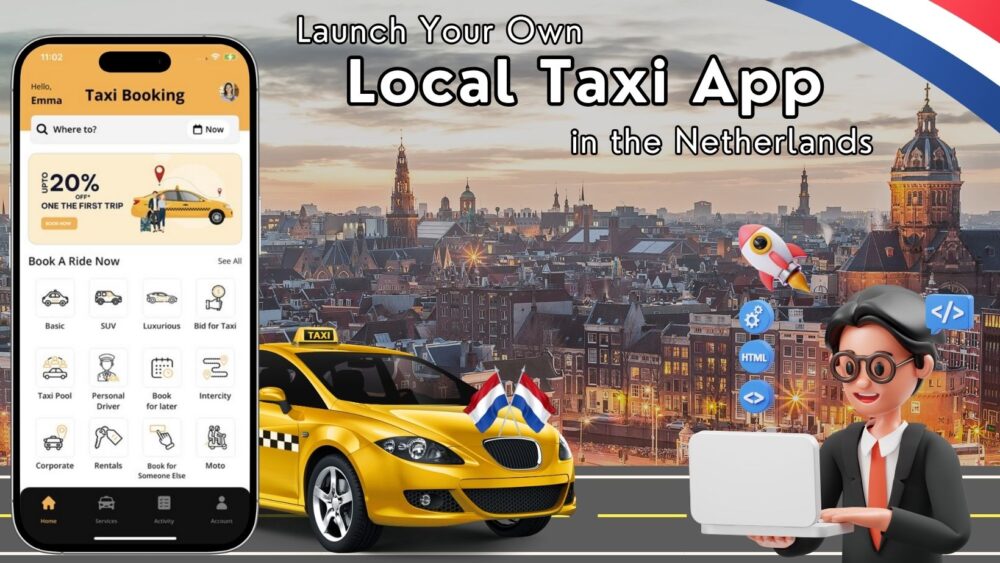
The Netherlands is known for its beautiful Amsterdam streets and its finest standard of living. While the Taxi Market in the Netherlands is vast, approximately over 1 billion Euros, and is growing exponentially. The approach of the users in the Netherlands is simple. They want specialized convenience for whatever amount they pay. This makes them an open spender in almost all segments. Their preference for convenience is inevitable. While Public infrastructure is good, demand for Taxi Apps is still growing. So, why not start a specialized Taxi App in the Netherlands?
In the following read, you’ll understand the market dynamics of a Taxi App and how to scale your wealth by starting a Local & specialized Taxi App in the Netherlands.
Enriched Living: The Need for Niche Taxi App in Netherlands
When we talk about the Netherlands’ Taxi Market, it’s not just big, but global platforms like Uber have already dominated the market. However, Uber is made for international standardization. Thus, anyone who actually thinks of starting a Taxi App in the Netherlands must know what the Netherlands’ market needs! Let’s roll out the problems in an elaborate way.
Underserved Small Towns:
Take a short drive beyond Amsterdam, and you’ll notice how fast the transport landscape changes. In smaller Dutch towns, finding a taxi is often a challenge, and even when one is available, reliability is hit or miss. Drivers cancel at the last minute, waiting times are unpredictable, and the customer experience feels inconsistent. Most global ride-hailing companies have chosen to anchor their operations in major urban centers like Amsterdam, Rotterdam, and The Hague, leaving small and mid-sized towns neglected.
Even within the larger metro regions, the lack of intercity taxi connectivity is a growing concern. Travelers moving between nearby cities often struggle to find dependable ride options, especially during late hours or peak travel seasons. What this shows is a transportation system that works well for a fraction of the population but leaves the rest underserved. This gap represents an open invitation for innovators who can create a bridge between smaller towns and major hubs, using technology and logistics to deliver consistent mobility everywhere, not just in the cities that already have it figured out.
Need for Niche Taxis:
The Dutch mobility landscape may be efficient, but it’s far from complete. While most ride-hailing platforms offer standard point-to-point rides, few cater to the growing needs of specific customer segments. Think about pet owners who struggle to find pet-friendly taxis, professionals who need luxury sedans for corporate travel, or senior citizens who require drivers trained to assist with mobility challenges. These aren’t small groups, they are significant, loyal user bases waiting for someone to serve them properly.
Most international taxi apps have adopted a single-format service structure, focusing on volume instead of value. This leaves vast niche markets untapped. The demand for specialized rides is increasing, and travelers are willing to pay more for comfort, reliability, and personalization. A dedicated platform that prioritizes inclusivity—offering options like premium cars, eco-friendly vehicles, or wheelchair-accessible fleets—can capture these overlooked segments. Each of these categories holds the potential to evolve into multi-million-euro business models on its own. The next phase of growth in the Dutch taxi industry will not come from scaling general services, but from mastering niche experiences.
Need for Reliable Technology:
In countries like South Korea, the United States, or the United Kingdom, taxi platforms have seamlessly integrated advanced technologies such as AI-based dispatch, real-time fleet tracking, and predictive demand mapping. The Netherlands, on the other hand, still operates with limited technological depth in many regions. Smaller taxi firms often rely on manual scheduling and outdated software that fails to optimize driver availability or route efficiency.
This gap becomes even more visible in specialized sectors. For example, wheelchair-accessible taxis or adaptive vehicles remain extremely limited. Medical transport services do exist, but they are often expensive due to operational costs. The government has capped prices to keep them affordable, but these caps make it hard for startups to remain profitable. Many medical transport platforms, despite high demand, shut down within months because their technology cannot sustain operational efficiency within restricted margins.
Uber Clone: A Perfect Solution for Taxi App in Netherlands
If you are looking to enter the taxi business or expand your existing fleet with a niche offering, an Uber Clone can serve as the ideal starting point. It is a pre-built, market-ready platform designed with the same efficiency, scalability, and technological sophistication that powers leading ride-hailing apps. The beauty of an Uber Clone lies in its adaptability. It can be molded to fit your unique business model, customer segment, and brand identity with ease.
Unlike traditional app development, which can take months or even a year, a white-labeled Uber Clone gives you a shortcut to market entry without compromising on quality or innovation. It comes packed with advanced features such as real-time ride tracking, dynamic pricing algorithms, multiple payment options, and in-app communication tools, all tested for reliability at scale. The solution also supports a wide range of revenue streams, including surge pricing, subscription-based loyalty programs, commission models, and corporate ride tie-ups. This ensures that your business starts generating revenue from the very first day of launch.
A white-labeled firm provides this pre-built platform and adapts it specifically to your brand’s requirements. Since it is a ready-made solution, the development process is smooth and predictable. The average launch cycle takes only about a week, which is a game-changer for startups and enterprises alike. You skip months of technical groundwork and move directly to brand positioning, testing, and deployment.
Here is how the process typically unfolds:
Step 1: Try the Demo Apps
Before making any commitment, you get full access to the demo versions of the rider and driver apps. This gives you a hands-on experience of the interface, usability, and performance. You can test all the core features in real-world scenarios to understand how the system operates before any customization begins.
Step 2: Discuss Your Requirements with the White-Label Firm
Once you are confident about the product, you move into the discussion phase. Here, the white-label development team works closely with you to define your business objectives, preferred features, and niche focus. Whether it is adding a luxury fleet, a pet-friendly ride option, or an AI-powered dispatch system, everything is mapped out according to your needs.
Step 3: Send Your Branding Assets
Next comes the personalization stage. You provide your logo, color palette, tagline, and any specific visual guidelines. The white-label team ensures that every interface element reflects your brand identity. From splash screens to driver badges, every detail is fine-tuned to make your app look and feel uniquely yours.
Step 4: App Customization and Quality Testing
After the branding assets are received, the development team customizes the app’s design, layout, and functionality. They implement the required integrations such as payment gateways, GPS tracking, and notification systems. Once the customization is complete, the app undergoes a rigorous testing process. Every function, from driver onboarding to ride completion, is tested under multiple real-world conditions to ensure smooth operation and high performance.
Step 5: App Launch Across Major Stores
Once testing is complete and your approval is in place, the white-label firm proceeds to publish your app. It is launched across major platforms such as the Apple App Store, Google Play Store, and iTunes Store under your company’s name and branding. The deployment process includes compliance checks, store listing optimization, and a complete handover of credentials so you retain full ownership and control.
Wrapping it Up
From there, you are ready to start onboarding drivers, attracting riders, and scaling your business. In just one week, you move from idea to execution with a robust and tested platform that is already proven in global markets.
An Uber Clone is not just a shortcut. It is a smart entry point into a competitive market. It saves time, reduces costs, and eliminates the common risks of building from scratch. With the right white-label partner, you can transform your vision of a niche taxi app into a thriving brand powered by advanced technology and a proven business framework.

Uber App Clone introduces the great taxi on demand business solution by launching a Uber App Clone providing white-labeled uber clone apps available in different languages and currencies.