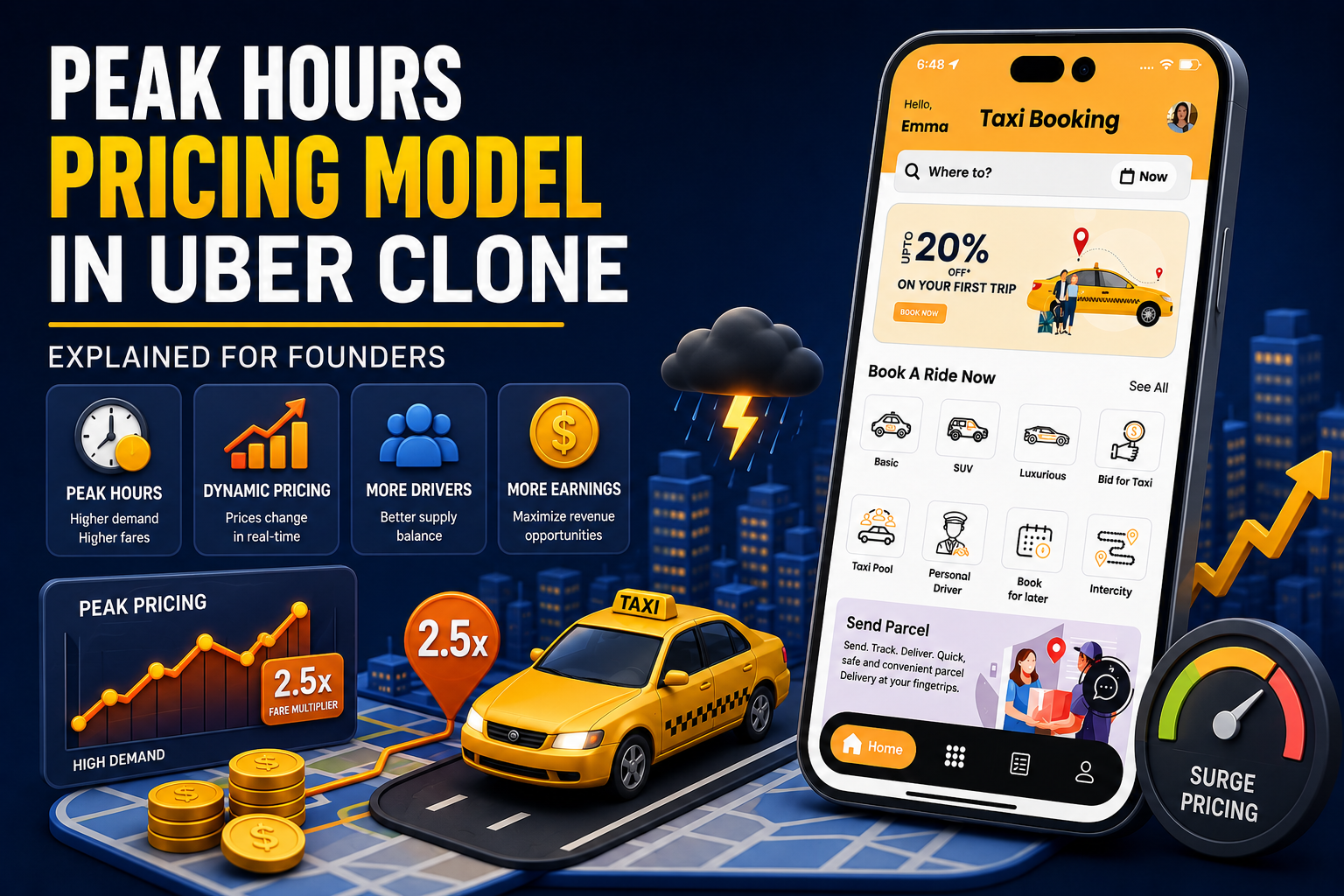
Many ride-hailing business owners clearly understand why peak-hour pricing helps balance driver demand without requiring significant effort on their part. But understanding the concept and actually implementing it without charging riders an unrealistic amount for the same trip are two very different things.
Getting this wrong without adequate market preparation can damage the brand reputation that you spent months building.
The good news is Uber clone handles this issue particularly well. That’s why it is highly effective to understand how most clone apps work, particularly for a taxi-booking platform in order to remain fair during peak hours.
Surge Pricing Is Ride Availability, Not Higher Fares
People in metro cities can easily check different mobile apps to compare surge pricing in a few seconds. But if you look at users from Tier-2 or Tier-3 cities, they often rely on your Uber clone app as their only option. This lack of competition requires a different approach to fare adjustments.
When your business is the only platform in a local market, sudden spikes in fare are very rarely seen as standard rates. In other words, riders see a huge surge in pricing and don’t think twice before uninstalling the app.
Many taxi-booking platform owners assume they can copy the surge-pricing models used by industry giants, and they are not entirely wrong. While the proven surge-pricing model works smoothly in large metro cities, it often fails in markets where many online taxi-booking platforms are still trying to build daily user retention against cheaper and more local alternatives.
The basic goal of peak-hour pricing is not to increase revenue but to maintain driver supply and guarantee ride availability when users cannot find local taxis during peak hours.
A 2026 study reported that improved demand forecasting and fleet repositioning reduced rider wait times by 31.1% on average which is a huge number considering most platforms never think about changing fleet positions or preparing for the demand of bookings in advance.
Overall, when you consider these factors to set pricing when bookings surge, keep in mind that ride availability will always outperform platforms that focus on making money for a short period of time.
What the Admin Panel Inside Your Uber Clone Script Actually Lets You Control
The admin panel plays a central role in setting the right price as per the situation demands. Here are some settings which the business owners can use to manage surge pricing effectively:
1. Setting Peak Hours Pricing by Areas
Instead of applying the same price across the entire region, a good thing is to use the peak hours setting to apply different pricing to different areas of the city. This is done because busy office areas will naturally have more bookings as compared to a quiet residential neighbourhood.
Therefore, your pricing needs to reflect the amount of bookings all while keeping tabs on what the competitions are offering to your riders. It is important to turn on surge pricing before the demand starts, not after.
2. Using Heat View and God’s Eye View Before Surge Kicks In
As mentioned earlier, it is important to turn on surge pricing before the demand starts. But when is that and how will we know in advance? Well, the heal view and God’s eye view features available in the Uber clone script allows the admin panel operator to see where the demand is growing naturally.
Using God’s eye view, you can track your drivers in real time and adjust the position of the fleet to tackle the bookings. Doing this will boost your acceptance rates and reduce the wait time.
3. Showing Fare Estimates Transparently Before Riders Confirm
When riders are surprised by high fares, they lose trust in your platform. Showing an estimated fare before they confirm a ride is crucial during peak hours.
- If a rider accepts a higher fare upfront, they feel in control
- If they see a normal fare and get charged extra at the end, they feel cheated and won’t think twice before switching apps
The assumption is usually that these higher fares help drivers, but that isn’t always true. A 2026 Gig Mobility Report found that while customer prices jumped by nearly 10%, driver pay per trip only went up by 3.6%. Just charging the rider more doesn’t automatically put that extra cash into your drivers’ pockets.
4. Using Geofencing to Contain Surge to High-Demand Areas
Many app owners make the mistake of running peak pricing across the whole city when demand is really only coming from a few specific locations. You can use Geofencing to draw boundaries around these busy areas and apply surge rates only inside them. This way, riders outside the busy zones just keep paying standard rates.
5. Pairing Promo Codes With Peak Hours to Protect Rider Loyalty
If your pricing strategy only focuses on increasing fares, you can easily push away your best customers. You can use Promo Codes to give targeted discounts to your regular commuters to help offset a peak fare. It is a simple move that shows you actually value their daily loyalty.
6. Activating Auto Payouts to Keep Drivers Online During Peak Windows
Drivers need to know they will be paid accurately for the extra hassle of driving during rush hour. The Auto Payouts feature settles their earnings automatically, and drivers who trust the system are much more likely to stay online. Uncertainty about getting paid is actually a very common reason why drivers just log off exactly when you need them most.
Set Pricing as a Trust System, Not Just a Revenue Tool
When you look at how all these settings come together, you realize that the most successful taxi platforms aren’t the ones charging the highest surge multipliers. Because charging more is not the point when you want to build your brand reputation or want to gain customer loyalty.
The reliable experience that your taxi booking platform is offering matters more and often outweigh the high fare. From the perspective of the rider, they want to know the price of their taxi booking upfront all while knowing that they will be picked up rather quickly than other platforms.
Not only does this kind of experience bring more loyal customers that a cheap ride where the wait time is high but the decision making from the business owner sets the tone for how people saw the brand.
Final Thoughts
The best way to handle peak hour pricing depends on many factors. Most of these factors come from highly advanced settings available in the admin panel of some of the most popular Uber Clone apps today. The better these panels are, the greater are the chances to handle surge pricing which is well-times, quickly communicated, and set differently as per the busy areas across the city.
You already have the built-in tools to avoid this. Features like the Heat View, Geofencing, Promo Codes, and Auto Payouts work best together to help you balance driver supply and rider loyalty at the same time. Most taxi booking apps today have these features available and ready to play a huge role in setting surge pricing.
When you stop treating these features as separate settings and use them as one connected system, your peak hours will stop bringing in complaints and instead become the exact reason people rely on your app.
FAQs
- Does raising fares during peak hours actually bring more drivers?
Drivers will chase peak pricing if they know their extra earnings will hit their accounts accurately. However, it all depends on the rider whether they tap on the final confirm booking button after seeing the increased fare on the taxi booking app.
- Why is peak hour pricing be different in different zones of the city ?
If you apply a flat surge rate across the whole city for two hours, you might make extra money in one busy area, but you are quietly ruining your reputation in those places where the demand of more drivers is not needed.
- How to know your peak pricing configuration is actually working?
A much better sign is simply checking if drivers are actually available during your busy hours. If more drivers are staying online compared to before you turned on peak pricing in your uber clone app, your strategy is working for the drivers. At the same time, if riders are canceling less and finding rides faster, it is working for the riders too.

Uber App Clone introduces the great taxi on demand business solution by launching a Uber App Clone providing white-labeled uber clone apps available in different languages and currencies.